
How to Host/Run a Home Poker Tournament
"The Definitive Guide"
Planning a home poker tournament? Use this step-by-step guide for structures, blind schedules, chip breakdowns, rules, payouts, and the gear you need to host a smooth, fair, and fun event.
The keys to a successful tournament: well organized, consistent blind structure, and quality poker supplies.
A Quick Home Tournament Setup
Use this as your default “plug-and-play” setup based on the $5,000 starting stack and $25/$50 starting blinds used in this guide. This is just a quick recommendation. Any of these values can be change to your preference.
Pre-build the players starting chips into chip trays before players arrive. It speeds up the start and keeps the tournament organized.
1) Choose a Format & Buy-In
Recommended: No-Limit Texas Hold’em, single-table or multi-table, freezeout (no rebuys) for fastest, predictable runtime.
- Players: 6–10 per table is ideal; use multiple tables for over 10 players. A table for every 6-10 players.
- Buy-In: Pick a comfortable amount for your group (e.g., $20–$100)
- Starting Stack: Any amount works! We will use $5000 as our example on this page. Pro Tip: The starting amount should be 100x your starting big blind.
- Antes (optional): Antes normally will kick in at a pre-determined blind level. Antes can be done one of two ways. Every player contributes an ante (usually 10 - 20% of the big blind) or just the player in the big blind position posts an ante equivalent to 100% of the big blind. Antes are posted at the same time that the blinds are posted, prior to the dealing of the hand.
- Bounties (optional): Every player buys a bounty chip (eg. $5-$10). Knock a player out, get their bounty chip (only their original chip). Keep all the Bounty chips you earn and cash them in at the end of the tournament.
- Rebuys (optional): A player that is knocked out prior to a specific blind level, has the option to rebuy back into the tournament..
- Add-ons (optional): Every player in the tournament has the option to buy more chips prior to a specific blind level during the tournament.
2) Set the Tournament Structure
Decide blind level length and total duration. For casual nights, target 3-5 hours total play. Generally speaking, the longer the rounds and the slower the blinds increase, the longer the tournament will last; this will reward skill. The shorter the rounds and the faster the blinds increase, the shorter the tournament will take; this will reward luck. You will want to find the right balance for your tournament.
- Level length: 12–15 minutes (quicker) or 20-30 minutes (deeper).
- Breaks: 5–10 minutes at times when you color up chips.
- Table balancing: Move players to keep tables within one player of each other. (eg. One table has 6 players, the other has 8 players; move 1 player to make both tables have 7 players each)
3) Create a Blind Schedule
Use a smooth, incremental schedule that avoids big jumps and preserves playability late. We will use a starting blind level of $25/$50 (big blind is 1% of $5000 starting stack). A tournament will normal end when the big blind is 10% of the total tournament chip count or sooner. (Example - 20 players @ $5000 each -- $100,000 total chips -- (10%) $10,000 big blind) Pro Tip: The starting Big Blind is 1% of the player's starting chip stack or the players starting stack is 100x the starting Big blind.
Example: 20 Players - Starting Chip Stack - $5000 - Tournament Time: Approximately 5 hrs
| Level | Blinds | Length |
|---|---|---|
| 1 | 25 / 50 | 20 min |
| 2 | 50 / 100 | 20 min |
| 3 | 75 / 150 | 20 min |
| 4 | 100 / 200 | 20 min |
| 5 | 150 / 300 | 20 min |
| BREAK | -- Remove $25 Chips -- | 5–10 min |
| 6 | 200 / 400 | 20 min |
| 7 | 300 / 600 | 20 min |
| 8 | 400 / 800 | 20 min |
| 9 | 600 / 1,200 | 20 min |
| 10 | 800 / 1,600 | 20 min |
| BREAK | -- Remove $100 Chips -- | 5–10 min |
| 11 | 1,000 / 2,000 | 20 min |
| 12 | 1,500 / 3,000 | 20 min |
| 13 | 2,000 / 4,000 | 20 min |
| 14 | 3,000 /6,000 | 20 min |
| 15 | 4,000 /8,000 | 20 min |
| 16 | 5,000 /10,000 | 20 min |
Pro Tip: Try using a poker tournament manager, it will simplify running the tournament. The manager will make your tournament have that true casino tournament feel. Using the manager will help you to focus on playing and not worry about all of the details. The manager will do many things to assist you. Its main function will be to act as the tournament clock and count down the rounds and increase the blinds. It will also produce a random seating chart, so everyone knows where to sit. If you have multiple tables, it will move players to balance tables and as needed, will close tables. The Manager will also keep track of who has paid and determine the prize payouts. All of these features are customizable to fit the needs of your tournament. WE HIGHLY RECOMMEND.
Use our customizable FREE Poker Tournament Manager.
Try our FREE Texas Hold'em Tournament Simulator.
4) Build the Starting Chip Breakdown
Pick three colors to simplify counting and color-ups. Example for a $5,000-chip stack (per player):
| Denomination | Color Example | Qty / Player | Total Value |
|---|---|---|---|
| $25 | Green | 20 | $500 |
| $100 | Black | 20 | $2000 |
| $500 | Purple | 5 | $2,500 |
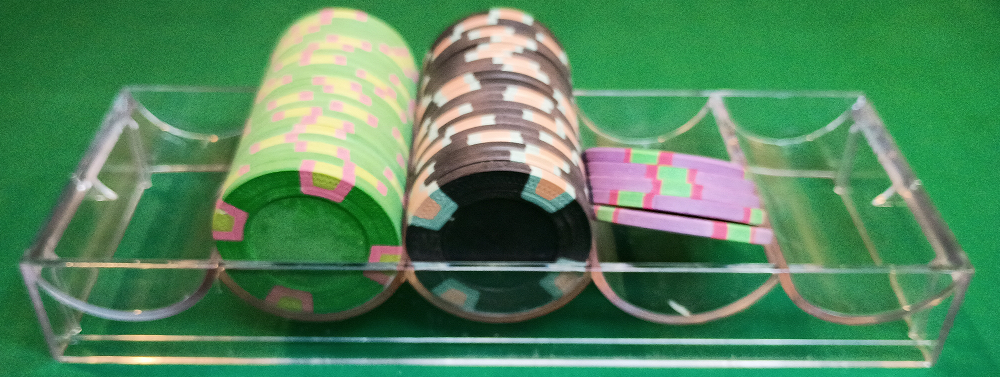
$5000 Starting Stack Example
(20) $25, (20) $100, (5) $500
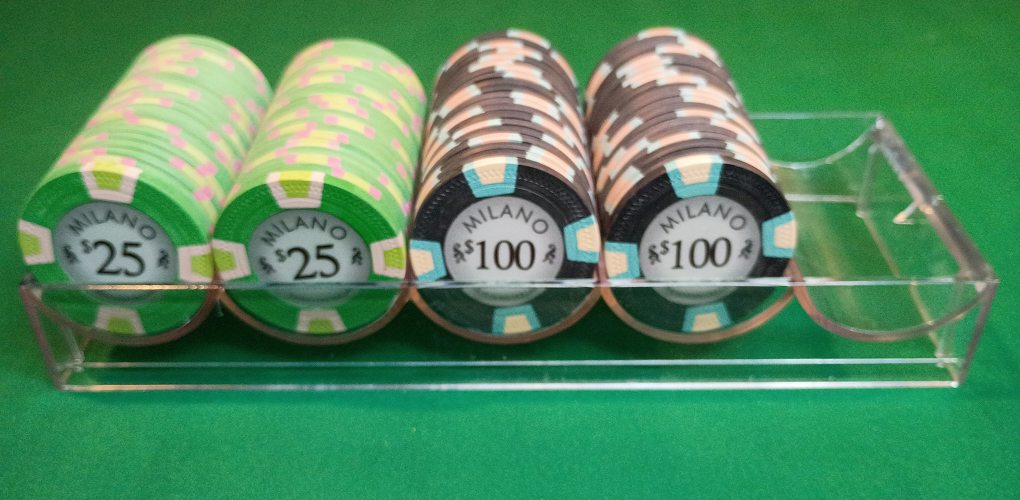
Alternate $5000 Starting Stack Example
(40) $25, (40) $100 - If you have the chips
This starting stack will help eliminate the asking for change from other players
Pro Tip: Color-up the lowest denomination of chips during breaks to keep stacks cleaner. Color up the $25 chips to $100 chips at the 1st Break. Color up the $100 chips to $500/$1000 chips at the 2nd break.
5) Define House Rules
- Seating: Random draw - Use the Seating Randomizer.
- Dealer button: The player that draws "Seat 1" at any table, will start as the dealer. Dealer button will then move one spot to the left (clockwise), with each hand played.
- Betting: Verbal declarations are binding; No string bets allowed.
- Rebuys/add-ons: If using, specify price, period (e.g., first Break), and stack size.
- All-in & showdowns: Table both hands when all-in and called.
- Etiquette: No splash pots; Act in turn; Hand will automatically fold, if player not at table; Phones on silent.
Seating - You will need to randomly assign seating to all players. Either use playing cards or our Seating Randomizer tool. If using cards, have each player draw for their seat assignment. Don’t allow players to pick their seats. Some players may want to sit on one side or the other of another player to get an advantage. You will also need to determine how many sit at each table. Give everyone enough room, don’t crowd them in. Add an extra table if you need too. Most large poker tables seat 8–10 players comfortably.
Multi-table - When playing with more than 1 table, as the players get knocked out, you will need to move players to balance the tables (keep all tables with in 1 player of each other). As more players get knocked out you will need to close tables, by moving all players from that table to other tables, until you eventually get to the final table.
Chip Color up
You can handle these extra chips in one of three ways, chip elimination, chip rounding up, or chip race off:
- Chip Elimination - The simple removal of all extra chips. (eg. player has 5 -$25 chips, they only receive a single $100 and lose the extra $25)
- Chip Rounding Up - (Most Popular Method) turning of any extra chips into the next chip denomination.(eg. player has 5 -$25 chips, they receive two $100 chips)
- Chip Race Off - Randomly determining which players get their extra chips colored up. Any player with extra chips is eligible to win a colored up chip. All of the extra chips are placed in front of the player. A player will receive one card for each chip that they have. The high card wins the chip.
6) Tournament Payouts
| Players | Payouts |
|---|---|
| 8–10 players | 1st 65%, 2nd 35% |
| 11–20 players | 1st 50%, 2nd 30%, 3rd 20% |
| 20+ players | 1st 50%, 2nd 25%, 3rd 15%, 4th 10% |
7) Equipment Checklist
- ✔ Clay Poker chips (500–1,000 for 8–20 players)
- ✔ 2 decks of playing cards per Table
- ✔ Roll-out poker table surface or dedicated poker tables
- ✔ Poker Table Cup holders - keep drinks from spilling
- ✔ Chip racks / Chip Carriers or Cases
- ✔ Timer (laptop/phone) & seating chart / Tournament Manager
Use our customizable FREE Poker Tournament Manager.
8) Hosting & Flow Tips
- • Announce start time and structure in advance; arrive early, collect the buy-ins, hand-out starting chips, and begin on time.
- • Use clear seat cards and table numbers or have Tournament Manager manage the seating.
- • Post the blind schedule and breaks where all can see.
- • After elimination, get a side cash game started to keep the fun going. Check out our Poker Hub for a description of many different poker game variations.
Have each player's starting chips organized in a single chip tray, ready to hand out, when they pay their buy-in.
Home Tournament Checklist
Before Players Arrive
- Set the format (Freezeout / Rebuy / Add-on / Bounty) and buy-in
- Build starting stacks in trays (one tray per player)
- Post the blind schedule where everyone can see it
- Prepare color-up chips for Break 1 and Break 2
- Set up tables/chairs (6–10 players per table)
- Put out dealer buttons, cards, and chip racks
- Open the FREE Poker Tournament Timer
Start of Tournament
- Collect buy-ins (and bounty chips if you’re using them)
- Assign seats randomly (seat cards or draw)
- Announce key rules (rebuys/add-ons window, etiquette, showdowns)
- Confirm payout plan before the first hand
- Start the timer and begin on time
During Play
- Announce level changes clearly
- Keep tables balanced within 1 player (multi-table)
- Move players only after a hand is complete
- Keep chips and pots tidy (no splash pots)
- Track who is still in and who is out
Breaks & Color-Ups
- Pause play at the end of the level (not mid-level)
- Color up $25 chips at Break 1
- Color up $100 chips at Break 2
- Reconfirm current blinds after the break
- Top off the table with higher denominations if needed
Final Table / End
- Confirm the payout amounts again when close to the money
- Use higher denomination chips to reduce huge stacks of low chips
- Pay bounties (if used) and prizes at the end
- Start a side cash game for busted players (optional)
Want this to feel like a casino tournament? Use the timer for blinds, seating, and pace.
Frequently Asked Questions
How long will a home tournament last?
Plan for about 3 1/2 hours for 10 players and about 4 1/2 hours for 20 players. This will always depend on number of players, starting chip amount compared to the starting big blind amount, length of blinds and the rate at which the blind amounts increase. A tournament will end when the big blind gets to 10% of the total tournament chip count.
How many poker chips do I need for a home poker tournament?
Roughly 50 chips per player; a 500 chips for 6–10 players and a 1000 chip set for up to 20 players. Only 4 colors/denominations will be needed (5 colors in larger tournaments).
What’s a good starting stack?
$5000 or $10,000 is a good starting amount, but any Amount works, as long as you have the chips for it. You will need enough higher denominations to cover the lower denominations during coloring up. The starting blind is proportional to it (first big blind is 1% of a players starting chip amount).
What’s a good buy-in amount for a home poker tournament?
Typical Poker Tournament Buy-ins can range from $25 to $100. This amount depends on the comfort level of your players. The goal is always to have fun, but having a large amount of in the prize pool adds excitement to the game.
How should I set up the blind structure?
You can start the blinds at any amounts that you want. Just make sure the big blind is about 1% of the amount that each player is starting with. Increase the blinds at a rate of no more than double of the previous blind every 15 to 25 minutes.
What is a fair payout structure for a home poker tournament?
Normally, the number of places that win money is based on how many people are in the tournament. A general rule is to pay 1st and 2nd place in a 10 person tournament. Then add one place for every 6-8 additional players after that. It really is your decision. Have a couple big winners or spread the wealth.
How many players can I have in my poker tournament?
This really comes down to 2 factors - Chips and Chairs. (1) How many poker chips do you have? You will need about 50 poker chips for every each player you have in the tournament. (2) How many poker tables/chairs do you have? Typically, you can seat 6-10 players per table and you will need a chair per player.
What equipment will I need for a poker tournament?
- Poker Chips - Have at least 50 per players consisting of 3-4 denominations
- Playing cards - 2 decks per table - this helps speed up the dealing process
- Poker Tables or Roll-out poker playing surfaces - each table can seat 6-10 players
- Chip Trays - Use these to have all starting chips organized. 1 tray per player, plus tray holding the chips used for coloring up later in the tournament
- Poker Timer or Tournament Manager Software - It is important that everyone knows what the blinds are at and how much time is remaining in the blind level
Should I allow Rebuys?
This rule is optional. If you use Rebuys, make sure everyone agrees to them. Rebuys are normally allowed only for a certain portion of a tournament (e.g., up to the first break). If knocked out, it gives you the ability to get back in, usually for the same price as the original buy-in and receiving the original starting stack.
Should I allow Add-ons?
Add-ons are offered at a certain point (like the first break) and are optional for all active players. This gives anyone the option to buy more chips to add to their current stack. Helpful if you are short-stacked. You determine the chip amount and price at your discretion.
Should I allow Bounties?
Every player buys a bounty chip (e.g., $5) during buy-in. When you knock a player out, you collect their bounty chip. If you get knocked out, you give yours to the winner. At the end, players cash in collected bounties. It is best to use a distinct chip style for bounties.